
 Nederlands
 Deutsch
 Svenska
 Polski
 Suomi
Suomi Español
 Français
 Português
 العربية
 Bahasa Melayu
 Italiano
 ไทย
ไทย Türkçe
 日本語
日本語 Български
 Română
 Ελληνικά
 Dansk
Dansk 简体中文
简体中文 繁體中文
繁體中文 Afrikaans
 Shqip
Shqip አማርኛ
አማርኛ Հայերեն
 Azərbaycan dili
 Euskara
 Беларуская мова
 বাংলা
বাংলা Bosanski
 Català
 Cebuano
 Chichewa
 Corsu
Corsu Hrvatski
 Čeština
 Esperanto
 Eesti
Eesti Filipino
 Frysk
Frysk Galego
 ქართული
 ગુજરાતી
 Kreyol ayisyen
 Harshen Hausa
 Ōlelo Hawaiʻi
 עִבְרִית
 हिन्दी
 Hmong
Hmong Magyar
 Íslenska
 Igbo
Igbo Bahasa Indonesia
 Gaelige
 Basa Jawa
 ಕನ್ನಡ
ಕನ್ನಡ Қазақ тілі
 ភាសាខ្មែរ
 한국어
한국어 كوردی
كوردی Кыргызча
 ພາສາລາວ
 Latin
Latin Latviešu valoda
 Lietuvių kalba
 Lëtzebuergesch
 Македонски јазик
 Malagasy
 മലയാളം
 Maltese
 Te Reo Māori
 मराठी
मराठी Монгол
 ဗမာစာ
ဗမာစာ नेपाली
 Norsk bokmål
 پښتو
پښتو فارسی
فارسی ਪੰਜਾਬੀ
 Русский
 Samoan
 Gàidhlig
 Српски језик
 Sesotho
 Shona
Shona سنڌي
سنڌي සිංහල
සිංහල Slovenčina
 Slovenščina
 Afsoomaali
 Basa Sunda
 Kiswahili
 Тоҷикӣ
 தமிழ்
தமிழ் తెలుగు
 Українська
 اردو
اردو O‘zbekcha
 Tiếng Việt
 Cymraeg
 isiXhosa
 יידיש
יידיש Yorùbá
 Zulu
ZuluBoth versions differ in the number of decks used in the game, slight lingo variations, as well as their names. The UK version is called Pontoon, but the Asian version can be found under the names of Treasury 21, Jupiter’s 21, Paradise Pontoon or Federal Pontoon.
This variant is played with several 52-card decks, while the European version is played with a single deck consisting of 52 cards. When it comes to the terms, the UK version uses twist instead of hit, stick instead of stand, and buy when the player wants to double the bet. Both versions follow the rules of American and European blackjack versions.
 Playing Pontoon = having fun
Although based on the American variant, the dealer has no hole card in Pontoon, just like the European version. Additionally, the dealer doesn’t peek for blackjack until the round ends, and if a player has a blackjack consisting of 5 cards, he wins double his stake.
What Are the Rules?
Although pretty much similar to traditional blackjack, Pontoon has its own set of tweaked rules which make the game pretty exciting. It can be described as a hybrid between the European and American variant of blackjack, combining the best features of both games.
Usually, the game is played with 2 players, although it works best with 5-8 players at the table. The UK version is always played with one deck of cards, except in cases of maximum players at the table (8) when the casino will use 2 decks. Everything else is the same as in standard blackjack – the objective of the game stays to beat the dealer’s hand while not going over a total value of 21.
Before the game starts, the banker needs to be selected. This is usually done by cutting cards – whoever has the highest number is the banker. Of course, this goes for land-based casinos – playing Pontoon in an online casino is only possible against the casino (banker). Next, the players place their bets on the table. There’s also a possibility of placing a side bet called Sweet 16 which is based on the two first cards dealt to the player. Sweet 16 pays 1:1 for a pair of aces, an ace and 16 or 21, and results in a push in case you get a pair of 2s or 7s.
Now it’s the dealer’s turn. He deals two cards face-down to the players and two to himself. Because of the no hole rule, the dealer doesn’t check for pontoon (blackjack) until the end of the round. In this way, it’s possible to get a natural and beat the dealer’s hand early which doesn’t happen in traditional blackjack or variations such as Spanish 21.
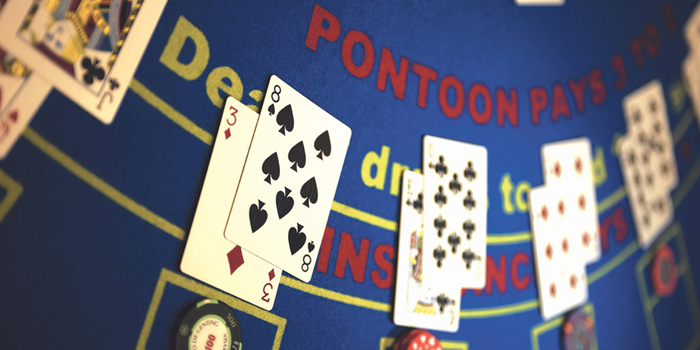 How do you beat the dealer?
The player can ask (twist) for up to 5 cards if their value doesn’t exceed 21 (bust). The dealer will always hit on Soft 17 in Pontoon, while also offering the same bonuses and side-bets available in Spanish 21.
Why Choose Pontoon?
Pontoon is a fun and exotic blackjack variant which pairs the best of both worlds (European Blackjack and American Blackjack). It’s pretty fun to play due to the lower house edge and the lack of a hole card, which gives you a chance to stay in the game for longer. Furthermore, the 2:1 payout will surely excite traditional blackjack punters, and the side-bets and bonuses are two more reasons to give this variant a spin.
As you can see, the differences aren’t in terminology only. If you feel that traditional blackjack is a bit dull, we suggest trying any of its variants, and Pontoon should definitely be at the top of your list.